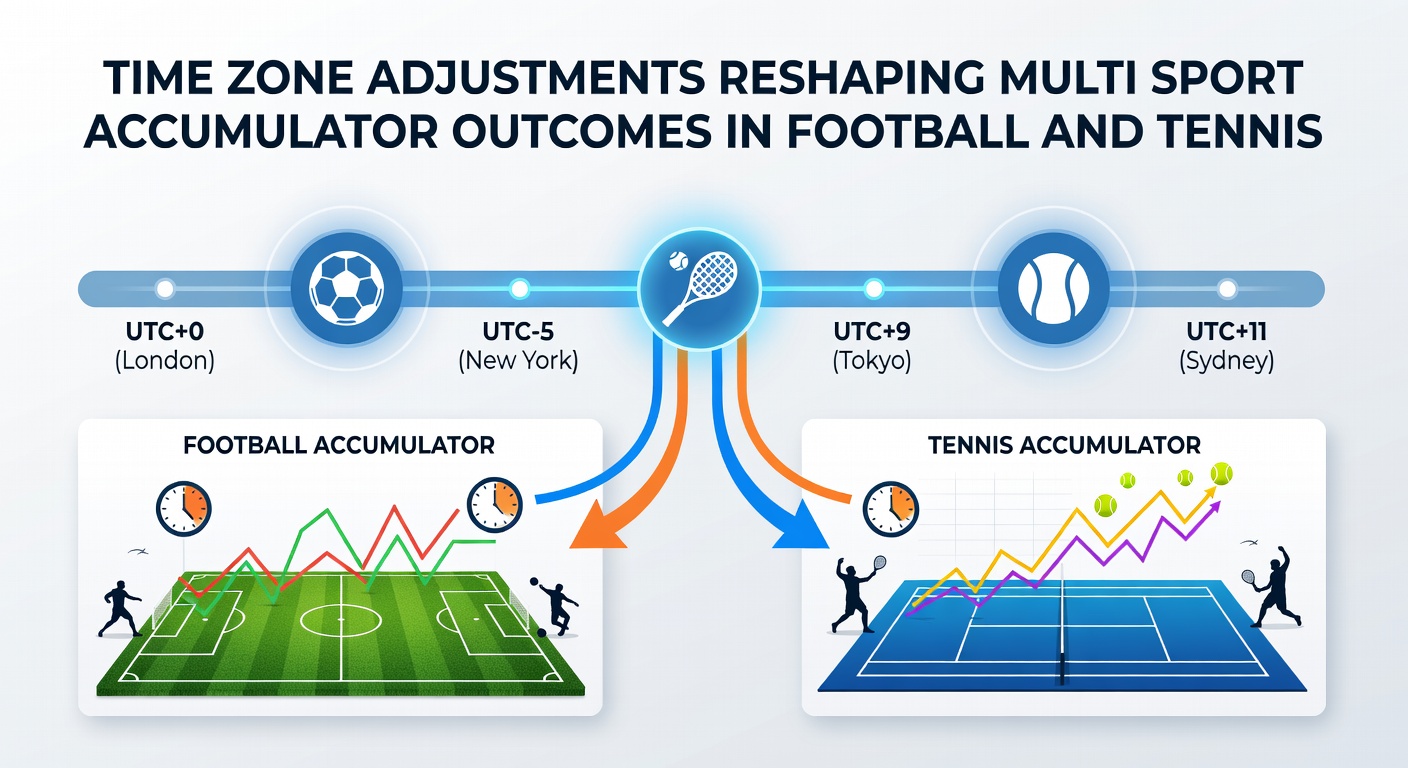
Clock Shifts Reshaping Accumulator Strategies in Football and Tennis Markets
Time zone adjustments continue to influence scheduling patterns that feed directly into multi-sport accumulator calculations for football and tennis events, and data from international sports bodies shows these shifts alter both performance metrics and betting market responses in measurable ways. Teams and players crossing multiple zones face documented disruptions in sleep cycles and recovery times, while bookmakers adjust lines accordingly ahead of combined wagers that span different continents.
Performance Data Tied to Travel Across Zones
Studies compiled by the Australian Institute of Sport reveal that athletes traveling eastward across three or more time zones experience measurable declines in reaction speed and endurance markers during the first 48 hours after arrival, whereas westward travel tends to produce milder effects that resolve faster. Football clubs competing in UEFA Champions League fixtures after long-haul flights from South America to Europe have recorded higher concession rates in opening halves, and similar patterns appear in tennis when players move from Australian swing events to European clay-court tournaments. These physiological shifts feed into accumulator models because bettors often combine a late-night South American league result with an early European tennis match, yet the underlying player output varies based on the direction and distance of travel.
Scheduling Changes in May 2026 Tournaments
Organizers of major tennis events scheduled for May 2026 have already published revised start times that account for broadcast demands across Asia and North America, and these alterations create new overlap windows for football fixtures in overlapping leagues. When a Madrid tennis match begins at 11:00 local time instead of its traditional slot, the corresponding accumulator ticket that also includes an evening Premier League game encounters different live betting dynamics because player fatigue profiles shift with the adjusted preparation period. Observers note that such changes compress recovery windows for athletes who finished previous rounds in distant time zones, and historical match logs from the ATP Tour indicate elevated error rates in tiebreak situations under these conditions.
Market Reactions in Accumulator Pricing
Betting exchanges respond to these variables by widening or tightening spreads on combined selections, particularly when football matches in the MLS conclude just hours before tennis quarterfinals begin in a separate hemisphere. Data aggregated by the European Gaming and Betting Association shows increased volatility in accumulator payout ratios during periods when multiple high-profile events cross time boundaries within a single calendar day. Bettors who construct tickets linking a South African football league outcome with a California-based tennis match must account for the fact that teams playing at altitude after eastward travel display statistically lower clean-sheet frequencies, while tennis players benefit from later start times that align better with their circadian rhythms.

Case Examples From Recent Seasons
One documented instance involved a Brazilian club traveling to a European midweek fixture and then returning for a domestic league match three days later, resulting in a measurable drop in goals scored during the home fixture that many accumulators had priced at higher totals. In tennis, players moving from Indian Wells to Miami in the same month have shown reduced first-serve percentages when matches tip past midnight local time, and these figures translate into lower hold percentages that affect live accumulator adjustments. Researchers tracking both sports have compiled datasets indicating that the magnitude of performance variance scales with the number of zones crossed rather than simply the total flight duration.
Adjustments in Data Modeling Approaches
Advanced analytics platforms now incorporate time-zone delta variables into their outcome forecasts, weighting recent travel history alongside traditional form indicators when generating probabilities for multi-leg bets. Football models factor in kickoff times relative to a team's home zone, while tennis projections adjust for set durations that extend into early morning hours after transcontinental flights. This integration produces revised accumulator odds that more accurately reflect the physiological load carried by participants, and operators have reported tighter margins on tickets that combine events separated by more than five time zones.
Conclusion
Time zone adjustments continue to exert measurable influence over both athletic output and the structure of multi-sport accumulator markets in football and tennis, with scheduling decisions made for May 2026 events expected to extend these patterns into the coming season. Organizations tracking global sports performance maintain datasets that link travel direction, recovery intervals, and match timing to statistical deviations, and these records allow for refined calculations that account for the cumulative effects across combined selections. As leagues and tours refine their calendars, the interaction between clock shifts and betting frameworks remains a central variable in outcome forecasting.